


September 17, 2026
EV charging is entering its retail transaction era
%20(1).png)
For much of the last decade, the EV charging industry has been focused on deployment. The aim was to secure sites and get chargers in the ground.
But if you were at ICNC earlier this month, one thing was clear; the focus is shifting.
Strategy&'s 2026 EV Charging Market Outlook explains why.
Europe's public fast-charging infrastructure grew 50% a year between 2021-2025, while the BEV fleet grew 45% a year, meaning infrastructure growth is outpacing EV fleet growth.
That gap is exactly why the competitive question is no longer "Can a driver find a charger?", it's increasingly "Why would they choose yours?".
Deployment is giving way to competition
When public charging was limited, drivers had little choice. They used the available site, even if the app was unreliable, price was unclear or payment was clunky.
But hardware is no longer scarce, and drivers with options behave differently. Suddenly the experience around charging becomes the decision maker.
- Is the charger working?
- Do I need to download another app?
- Is the price clear?
- Can I pay how I want to?
- Can I trust the session to start and finish without hassle?
As charging becomes more available, these details become commercial differentiators.
More infrastructure creates customer choice
The strongest evidence that EV charging has become a transaction market is in the gap between infrastructure ownership and number of charging sessions.
If plug ownership dictated who wins the driver, the numbers below would roughly line up. According to P3's eMobility Excellence 2026 report, they don't:
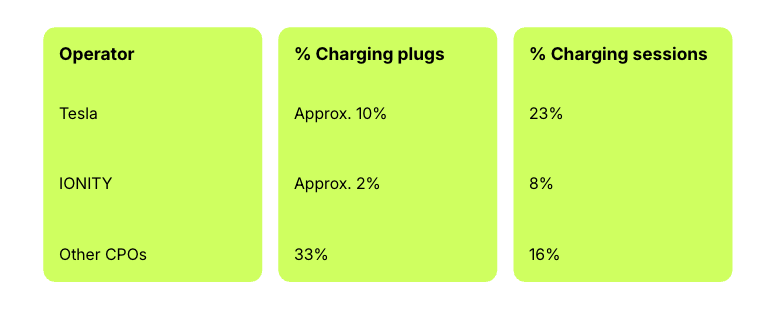
Tesla captures more than double its plug share in sessions, while "Other CPOs" sit at roughly half theirs.
Clearly owning more plugs doesn’t automatically translate into more customer demand; something else is winning drivers over, so what is it?
A survey of 402 EV drivers showed that network coverage now matters less as a selection criterion, while pricing transparency and app quality matter more:
- 96% consider tariffs important
- 74% want price information in station details
- 43% cite the lack of cost information as a problem
Strategy&'s survey of European CPOs backs this up from the operator side: 55% say user experience is now an increasingly important driver of customer choice.
If drivers encounter fragmented pricing, app friction or payment restrictions, they have every reason to choose another site next time. Location and coverage still matter, but the transaction experience is becoming a vital way to differentiate.
Charging is becoming an everyday retail service
This shift is also reflected in where drivers want to charge.
P3's survey found that the most preferred charging locations are:
- Retail and leisure destinations: 69%
- Urban public charging: 65%
- Motorway fast charging: 55%
Charging is now fitted around shopping, work and local travel, meaning drivers will judge it against the standards they experience in other retail transactions. They expect to know what something costs, expect the payment to work, and expect the information in-app to reflect reality.
At present, there is still a clear gap between that expectation and the experience delivered. P3 found that 49% of drivers say live charger availability shown in apps does not match the reality when they arrive.
That’s not a minor technical issue; it damages trust at the exact moment the customer is deciding whether to use a network again.
Recognise who’s arriving at the plug now
More affordable models such as the Dacia Spring, Leapmotor T03 and Citroën ë-C3 are also bringing new buyers in, and EU EV sales reflects that shift: up 36% year-on-year in August 2026.
Many new owners will judge public charging against the everyday retail experiences they already expect, and for those without home charging, particularly in urban areas, public charging is not a back-up. For instance, around 40% of UK households lack off-street parking, so they’ll rely entirely on public charging. The experience therefore needs to be dependable, transparent and easy to pay for.
As the market broadens, public charging cannot feel like a specialist service, it needs to work as simply as any other everyday payment experience.
The commercial challenge has changed
Fast charging hardware needs to be reliable, properly located and well maintained, but hardware alone is no longer a sustainable advantage, and CPOs know it.
In Strategy&'s survey of 22 European CPOs:
- 70% named payment UX improvement as a key initiative for the next 12 months
- 37% flagged payment friction as one of their customers' biggest pain points
- 59% are prioritising utilisation and asset productivity
In the next phase of the industry, owning the most plugs won't decide who wins.
Getting the transaction right will.